
New construction: 28 homes | Irenestraat, Rijssen
© wienerberger B.V.

Driving social housing circularity

architectum edition #43

New construction: 28 homes | Irenestraat, Rijssen
© wienerberger B.V.

28 social housing units, Rijssen

in The Netherlands

New construction: 28 homes | Irenestraat, Rijssen
© wienerberger B.V.

Products used

Menton HV ClickBrick, Blauwrood Genuanceerd HV ClickBrick, MaduraMax natuurrood+

Driving social housing circularity

By choosing fully recyclable products, buildings are becoming a future source of material and inspiration. Thinking in closed loops sets the new standard for sustainable planning – considering tomorrow’s needs by using future-proof raw materials today.

Sustainability with character

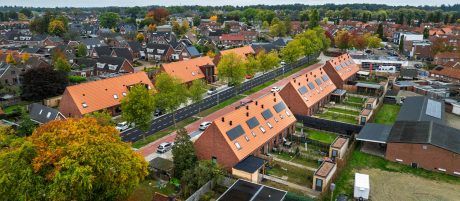
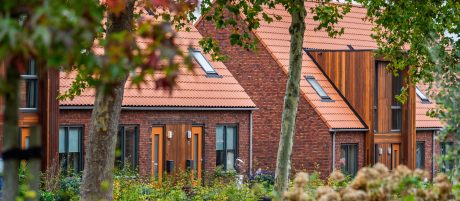
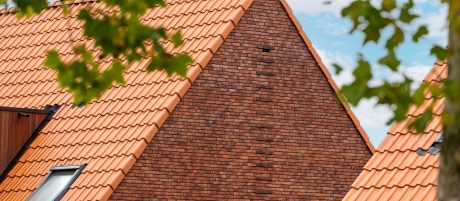
Sustainability was key: Commissioned by the association Viverion, a unique residential project of twenty-eight social housing units provides homes for young people, seniors, and small families in Rijssen, not far from the German border in the east of The Netherlands. The houses itself are constructed from recycled wood and prefabricated elements, while the façades and roofs are made entirely of reusable ceramic materials. Using Menton HV and Blauwrood Genuanceerd HV – two products from the ClickBrick series – for the façade and MaduraMax for the roof, the houses become fully circular – constructed without mortar or composite systems, making all components easy to dismantle and reuse. The extra-large MaduraMax clay roof tiles in natural red add the classic look that fits perfectly with the neighbourhood. The development on Irenelaan demonstrates how a social housing project becomes an inspiring example of how sustainability, circularity, and architecture create a contemporary, high-quality and affordable living environment. Architect Martin Huiskes of Architecten VOORMORGEN speaks about the importance of material choices in creating future-proof buildings.

Circularity has become a buzzword, but it is also becoming part of the legal agenda in many countries. What does circularity mean to you in practice?

Martin Huiskes: Circularity and sustainability are much more than trends; they’re at the heart of our mission to create environments ready for tomorrow’s challenges. As an architectural firm, we believe it’s our role to inspire and challenge our clients in the areas of sustainability and circularity. We believe we shouldn’t build more than necessary and that what we build should be as compact and circular as possible.

At what stage do you think of material choices regarding circularity?

Martin Huiskes: That differs from project to project. We can create a functional design and can make material proposals in collaboration with manufacturers, so that we have the greatest control over the environmental impact. Often, material proposals come from demolition companies and material suppliers. We always strive for materials with the lowest possible environmental impact.

Where do you need suppliers and contractors to get on board? How did wienerberger support the idea of material circularity?

Martin Huiskes: wienerberger offers several strong materials that align well with the principles of the circular economy. Their attractive ceramic and demountable products retain their value and can sometimes outlast the building itself.

For this project you chose to work with ClickBrick. What makes ClickBrick more circular than a wall of brick and mortar?

Martin Huiskes: We were aiming for the lowest environmental impact possible, which is why we chose ClickBrick. A traditional brick façade still has a higher impact than what we were aiming for. ClickBrick is a demountable façade system that retains the aesthetics and low-maintenance quality of brick, but with a much higher residual value and ease of detachment. The facing bricks are mounted without mortar, so that they can easily be reused later. 

„Even though the appearance of the guesthouses is rather unusual for Korea, the material resembles traditional roof tiles and blends into the Korean landscape while remaining contemporary.” - Kang Jun Lee, Architect

How did you approach the project in terms of planning and modelling? 

Martin Huiskes: To be able to apply the ClickBrick, the façade needs to be carefully worked out. We did this using a Building Information Model (BIM). With input from wienerberger, we model the façades in a way that saw waste is minimised while ensuring the design remains technically feasible. The engineering and execution required careful preparation, but thanks to the excellent collaboration with wienerberger, the process went very smoothly.

Apart from circularity and sustainability – what else did you like about the ClickBrick? 

Martin Huiskes: The bricks in the ClickBrick range are very attractive, and there is still room to grow. In my view, this is only the beginning, with opportunities for much greater variety ahead. The next logical step would be to make it standard practice and to use demountable systems only.

Sustainability is not only a matter of material choice, but also a matter of design. A beautiful building will be used for longer than one that’s out of fashion in a few years. What’s your take on this?

Martin Huiskes: Beauty protects a building from demolition. The value and importance that people attach to a building ensures its preservation. That’s true sustainability. This is more powerful than any energy performance measure, but it’s also less controllable and kind of arbitrary, because it is a matter of emotion. In our quest for ultimate sustainability, emotional motivations always prove to be the guiding principle.

This social housing project is technically fully prepared for the 2050 circular ambitions while preserving the familiar look of the neighbourhood. How did colours and materials support your approach?

Martin Huiskes: The original buildings consisted of single-storey houses with a pitched roof. In the new situation, we’ve retained that shape and character and wanted to give it a modern twist. The large, warm orange roof and the projecting wooden façade elements give the street a new character. Combined with the warm brick tones of Menton HV ClickBrick und Blauwrood Genuanceerd HV ClickBrick, it creates a familiar look that blends seamlessly with the surroundings.

Also, on the roof you collaborated with wienerberger, choosing the MaduraMax ­natuurrood+. Have you worked with this tile before? 

Martin Huiskes: We have worked with this ceramic roof tile before. The main advantage of this tile is its size, which makes it particularly well-suited for large roof surfaces. Fewer tiles are needed to cover the same area, reducing labour and allowing the roof to be tiled more quickly. These roof tyles are, of course, fully demountable and retain a high residual value.

Would you say this is a way of building for the future?

Martin Huiskes: But of course. We need to build in a way that allows materials to be used for as long as possible. This can be achieved by designing with beauty in mind, using demountable elements that retain their value and that are made from raw materials with the lowest possible environmental impact. 

New construction: 28 homes | Irenestraat, Rijssen
© wienerberger B.V.

Get in contact with us

More inspiration

Download

All editions

Wall

Get inspired by more examples of outstanding brick architecture with emphasis on the character and structure of a building.

Pavers

Endless design and application possibilities for private gardens, public spaces and historic places. Get inspired!