Facade cladding: Actua Naturrød | Gylteveien 4, Norway
© Wienerberger AS

A fifth façade facing the fjord

architectum edition #43

Facade cladding: Actua Naturrød | Gylteveien 4, Norway
© Wienerberger AS

Gylteveien 4, Drøbak

in Norway

Facade cladding: Actua Naturrød | Gylteveien 4, Norway
© Wienerberger AS

Product used

Actua Natural Red

A fifth façade facing the fjord

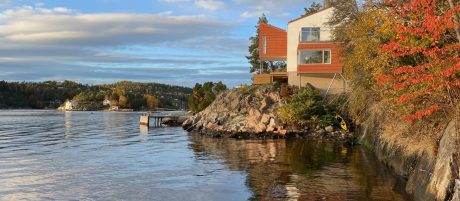
Located on the weather-beaten coastline of the Oslofjord, this house impressively demonstrates, how tiles on roof and façade shape a resilient home that connects tradition and modernity.

Ready for every condition

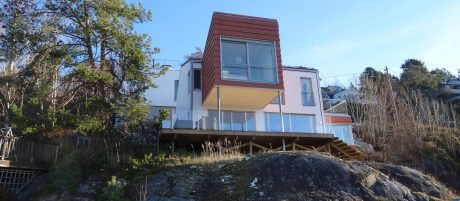
Only a 30-minute car drive south of Oslo one can find the picturesque town of Drøbak, both a refuge and tourist magnet neighbouring the capital of Norway. On Gylteveien 4, a steep, rocky site directly on the coast of the Oslo fjord, a detached house demonstrates how contemporary architecture is anchored within landscape and tradition. Completed in 2024, the single-family house reflects Norwegian traditional wooden architecture but supplemented by prominent extensions in red brick. Initially, the team explored brick for the main volume and wood for the extensions, but the plan evolved towards the opposite. Using white vertical wood cladding on the main volume and red roof tiles was reminiscent of the architectural tradition of the area, while the fully red extensions add a soft modern touch.
 
The material choice was not only an aesthetic one: “The location by the sea required materials that can withstand salt spray,” explains Line Stokholm, partner and general manager at Kile Stockholm Arkitekter. The sea spray often reaches high up the slope, and the winds can be strong. The result is a largely maintenance-free exterior that protects the underlying structure. 

Working with what’s there

Located just outside Drøbak’s conservation zone but surrounded by traditional white timber homes, the design needed to balance materials with local context. “Designing this house was an exciting challenge, both because of the strict zoning regulations and the steep terrain,” Stokholm explains.
 
Rather than changing the rugged terrain, the project minimized interventions: rocky outcrops and natural formations remained largely untouched. “Our vision was to utilize the qualities of the site, create good outdoor areas despite the slope, and fulfil the owner’s wishes for a room design with three bedrooms and as much living space as possible.” 

A durable coastal skin

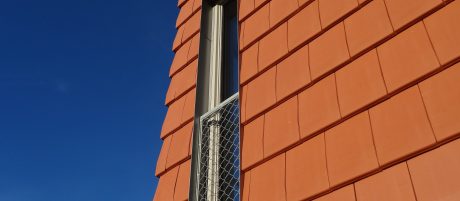
For the cladding Actua Natural Red roof tile was a centrepiece of the architectural concept – a modern flat double-seam system which can be used on both vertical and horizontal planes. On the roof and all other surfaces of the extensions, the Actua Natural Red becomes the defining element. It creates a unified exterior that stabilizes the house against the wind and the sea. “With Actua, we benefitted from a simpler and more efficient process on the construction site,” says Stokholm. “Since a carpenter can install it, like regular cladding, we don’t have to involve an additional tradesperson like a bricklayer. This makes the process both faster and more cost-effective.”
 
Beyond logistics, the choice reinforces architectural clarity. “Limiting the number of materials creates a stronger and more harmonious expression,” she adds. “Clay materials are rewarding and beautiful – they stand the test of time and give the building a lasting impression.” 

Facade cladding: Actua Naturrød | Gylteveien 4, Norway
© Wienerberger AS

Facts & Figures

Project name: Gylteveien 4, Drøbak, Norway

Architecture  Kile Stokholm Arkitekter

Client  Private

Year of completion   2024

Product used  Actua Natural Red  

Building type  Single Family House

Edition  architectum #43

Facade cladding: Actua Naturrød | Gylteveien 4, Norway
© Wienerberger AS

Get in contact with us

More inspiration

Download

All editions

Wall

Get inspired by more examples of outstanding brick architecture with emphasis on the character and structure of a building.

Sustainable Solutions

Dive deep into projects that provide brick-based architectural answers to ecological and social challenges.